Founding
Reditus ad Naturam
The history of science is a winding and wondrous path filled with distinguished characters, fascinating stories, and startling ambition, shaped over time by many different ways of seeing and engaging with the world.
Beneath this history sits our primitive instinct to make sense of the natural world. It is the urge to recognize patterns, construct causal stories, and orient ourselves within experience that has guided human inquiry across history, long before formal disciplines or institutions gave us the behemoth structures of post-modern science that we have today. As this instinct expresses itself over time, it takes on form through culture, language, and tools, gradually becoming a vast and fluid enterprise. Ideas rise and fall, paradigms intersect, and argument, rhetoric, and interpretation all contribute to what we come to understand as knowledge.
Heterodox Research Society was founded to engage with this broader view of science, one that recognizes its plurality, its contingency, and its fundamentally human character.
As may perhaps already be obvious, our work is deeply inspired by the provocative writings of Paul Feyerabend, the Austrian philosopher of science who never shied away from clashing with the scientific establishment of his time. Once labeled in a Nature publication as “The Worst Enemy of Science,” Feyerabend famously wrote Against Method, where he argued that when one examines the actual history of scientific discovery, one does not find examples of a rigid Scientific Method being consistently employed. Rather, one finds that many of the greatest discoveries emerged precisely through the breaking of methodological rules. Nearly every proposed scientific methodology can be found, somewhere in history, to have been violated while still producing remarkable discoveries.
Thus, it is often the abandonment of methodological certainty, rather than rigid adherence to it, that gives rise to genuinely new ideas. Being both rattled and inspired by Feyerabend's work, and by continued engagement with many of his other writings, it became increasingly clear to us that the present culture of science is poorly positioned to embrace such an anarchic epistemology, despite the possibility that it may ultimately be in our best interest.
Looking more broadly, we found a scientific enterprise marked by hyper-specialization, administrative expansion, declining public trust, and an apparent scarcity of radical material breakthroughs despite unprecedented resources. Increasing the heat of the moment, artificial intelligence has entered the scientific conversation, accompanied by confident declarations that sufficiently powerful models will soon “solve science.” Thus questions of scientific culture, epistemology, and the institutions that shape them have become more important than ever.
How did we arrive here?
The Structural Reflection of Science
In the post-war era, the institutionalization of science introduced structure, scale, and coordination at an unprecedented level. At the same time, a gradual narrowing took place. A particular interpretation of a universal scientific method became dominant, and institutional incentives increasingly favored safety, repeatability, and legibility, often at the expense of exploration, speculation, and intellectual risk. Over time, this has produced a form of methodological ossification, whose effects are visible throughout modern research as scientific activity has expanded dramatically, with more researchers, greater funding, and an exponential increase in published work. Thus, a troubling pattern has emerged whereby the number of researchers required to produce meaningful advances has steadily increased, while the associated scientific output per researcher, and per dollar invested, has declined across many domains.
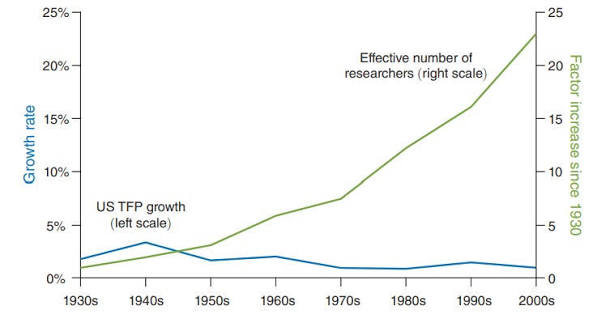
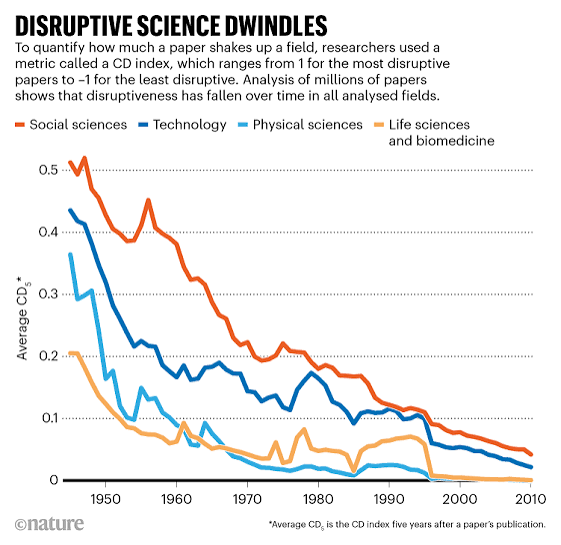
“You see an exponential growth of scientific papers... I could summarize in a bit of a pejorative way by saying these papers are mostly about well-dressed trivia...”
Didier Sornette, ETH Zurich
The problem science faces, then, is not one of scale. We have never possessed more laboratories, researchers, journals, funding, or computational power. Something deeper appears to be miscalibrated, something within the underlying DNA of modern science itself has become exhausted.
A more concrete manifestation of this miscalibration may be found in the now widely recognized reproducibility crisis. Roughly seventy percent of published research findings cannot be independently replicated, while many researchers struggle even to reproduce their own results. This phenomenon is often framed as a bureaucratic failure or a lack of sufficient adherence to methodological standards. Yet we suspect something more fundamental stirs beneath our noses. That is, if one cannot reliably reproduce certain results, perhaps it is because one does not understand said results in the first place. The reproducibility crisis is therefore not merely a failure of method, but a symptom of something far deeper. At a deeper level, science simply does not understand itself.
If science is to escape these doldrums, it must first come to understand itself, for how can one grow without first understanding its own nature?
Miscalibration
The project of creating the machine of discovery was initiated not in Silicon Valley, but nearly four centuries ago. In his Discourse on the Method, René Descartes envisioned science as a means to “render ourselves the masters and possessors of nature.” The phrase itself reflects a profound shift in humanity's relationship with the natural world whereby nature became increasingly understood as something external to be conquered, a mechanism to be analyzed, thwarted, and ultimately mastered. Therein science became a sword against nature, rather than a bind through which we may communicate with her. The Scientific Revolution and Enlightenment brought with them a growing confidence that science, and its practitioners, possessed privileged access to truth, and that through sufficiently rigid methodological standardization, the Scientific Method™, we might steadily unlock the universe until little mystery remained. Such ambitions were, in many respects, extraordinary successes. But this success breeds arrogance, and can lead one away from the holy path. The reductionist impulses of the Enlightenment form much of the foundation for our present and rather narrow conception of scientific discovery. Today, this inheritance has simply taken a new form. There exists a growing notion that with sufficient compute, larger language models, and enough data, one can uncover all of the universe's secrets. But what does it even mean to “solve science”? The question is, in many ways, preposterous. It is akin to asking whether we might someday solve art, solve religion, or solve love. Such notions do not really mean anything at all. Our interpretations of nature's patterns are not, as many in recent years have claimed, “settled,” nor should we expect them ever to be. In many ways, it is through messy human forces like rhetoric and argument that scientific understanding has advanced, far more than contemporary scientific mythology is willing to admit. Thus science is not merely the accumulation of settled facts, but an ongoing and fundamentally human activity.
The great miscalibration took place when we gradually exchanged natural philosophy for science, or more specifically, for a particular reductionist and empiricist brand of science that now dominates much of modern thought. The Baconian project yielded extraordinary fruit throughout various periods, though perhaps it has since claimed more successes than ought properly be attributed to it. Ultimately, this orchard could never sustain the scientific enterprise indefinitely. When people remark that “there is no fruit left on the trees of science,” an important distinction must be made—that it is not nature which has been exhausted, rather it is one particular conception of science that has largely harvested the fruit available to it.
We must now look onward to new orchards.
One pervasive misconception embedded within reductionist accounts of scientific progress is the assumption that knowledge unfolds as a simple cumulative progression toward truth. Popular accounts often imagine theories neatly replacing one another as increasingly accurate approximations of reality, yet the history of science has rarely been so “rational.” Competing theories frequently introduce entirely new conceptual worlds, with assumptions, categories, and standards that cannot be cleanly translated into one another. Scientific revolutions are often transformations in perspective rather than simple additions to an ever-growing body of knowledge.
This understanding stands in sharp contrast to the Popperian culture that has come to dominate much contemporary scientific discourse. A culture preoccupied with demarcating science from pseudoscience, defending established paradigms, and protecting institutional legitimacy frequently leaves little room for inquiry beyond accepted boundaries. One should think of science as more of an activity—the process of inquiring with nature—rather than the mere encapsulation of a well-defined and validated pool of knowledge and facts.
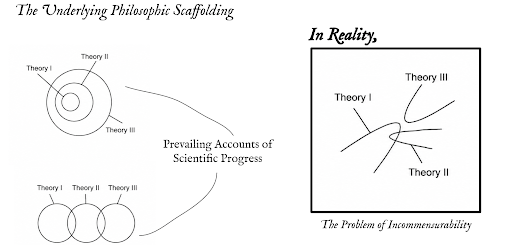
The diagrams presented here, “Prevailing Accounts of Scientific Progress,” illustrate three different conceptions of how knowledge evolves. The Popperian model presents scientific progress as a largely linear process, where theories continually overtake one another as new information becomes available and falsifications accumulate. Knowledge progresses as an expanding sequence: an initial theory is eventually surpassed by a second, more explanatory theory, which is then itself incorporated into an even broader and more encompassing framework later.
Thomas Kuhn's model of paradigms, while certainly more palatable than Popper's, still retains an underlying coherence between successive scientific worlds. Paradigms may represent distinct conceptual frameworks, yet they remain enclosed bodies of knowledge whose boundaries and predictive capacities remain, at least in principle, identifiable.
Feyerabend's model of incommensurability provides a more radical and, perhaps, more realistic picture of scientific development. Scientific theories are not merely larger circles that encompass their predecessors, nor are they entirely isolated worlds without connection. Rather, they often possess open-ended boundaries, distinct conceptual structures, and forms of understanding that resist simple translation between one another. Some overlap may exist, but such overlap is frequently reconstructed after the fact, reflecting our desire for continuity and coherence.
This scaffolding, while abstract, is nonetheless important for visualizing our prevailing assumptions about knowledge and how they may differ from the reality of scientific inquiry. If we are interested in cultivating a flourishing future of science, embodied by a culture of scientists who grasp the essence of their efforts, and especially if we seek to build artificial systems capable of reasoning about the world and generating genuinely novel theories, then grappling with these questions is a necessary foundation.
A Return to Nature
Meaningful institutions that stand the test of time are less like buildings that undergo a planning and construction phase, and more like tall, strong oak trees that emerge as a result of the proper conditions. A true, natural institution can be simply described as a collection of people, organized to some extent, and unified by some shared prerogative. This is seemingly well understood, or yet proclaimed to be, however it is rarely practiced. That is because many wish to create institutions, and so their patience can run thin, resorting to methods involving the artificial replication of a process that is fundamentally natural.
This is not to say that institutions do not emerge through intention. Indeed, they do. One may set out to cultivate an institution, just as one plants crops for a future harvest. Or sometimes a wonderful blossom simply appears unexpectedly. Yet there exists a delicate balance of sunlight, water, weather, and environment that the cultivator must maintain. Surely one may increase its inputs of sunlight and water and kill the blessed plant. Or one may treat it gently, yet place it within an inappropriate climate, and it too will perish. Or one might even genetically modify it to accelerate its growth, but such a creation will always be recognized as a mutant amongst beautiful natural forms. The same is true of institutions. One may influence the conditions from which they emerge, but cannot simply command them into existence. Such laws of emergence cannot be disobeyed, though men and women alike will never cease trying to undermine them.
It is upon this natural course that we hope to awaken this forgotten conception of science and inquiry within the minds of individuals, organizations, and, indeed, the very institutions that may once have been hostile to such thinking. We do not seek to build an institution in the conventional sense, but rather to cultivate the conditions from which one might naturally emerge.
Feyerabend once said “the only principle that does not inhibit progress is: anything goes.” In hoping to advance his words further and in non-totalizing fashion we are aspirationally guided by the principles of Radical, Open, and Decentralized Science.
Radical
To embrace fringe topics beyond the set of acceptable domains, often requiring new, unconventional, or what others may dismiss as “inferior” methods. Thus, to seriously engage questions of methodology is to ask how one actually conducts inquiry, how one thinks inside the laboratory, and how different modes of thought shape discovery itself. Just as one researcher may be guided primarily by empiricism, another may be guided by intuition. Just as some are driven by analytical rigor, others may be informed by symmetry, beauty, or metaphysical speculation.
As such, in seeking to cultivate radical science, we believe there are particularly opportune directions to explore in the form of Novel Physics, New Cosmologies, Theories of Everything, Health and Longevity, and a further exploration of the mysteries of Human Cognition.
Open
Openness may be expressed internally or externally and should not be confused solely with public transparency, as there can be found many examples of flourishing science existing without outward transparency to the public, but with an internal openness that breaks down domain barriers, enabling collaboration and interdisciplinarity. That is not to stray away from the open-source culture that our team comes from, and indeed we believe open science stands as a low-hanging fruit from which many laboratories can benefit. What matters is not whether every notebook is public, but whether the research environment permits the collision of fundamentally different perspectives.
Let there be engineers working alongside philosophers, chemists alongside artists, physicists alongside poets, and amateurs alongside experts.
Decentralized
It is individuals of every form who have mapped the heavens, dissected anatomy, formulated theories, and split the atom. Such individuals deserve support, but they must also possess the cultural freedom and self-sufficiency to pursue questions independently, without complete reliance upon institutional permission. We seek to break open new frontiers of thought whereby individuals can advance radical new knowledge, and new centers of inquiry can emerge. The optionality for one to migrate between scientific cultures and domains of inquiry can only be possible if there are sufficient tools and infrastructure for enabling this mobility of individual thought. In celebrating and supporting individualism in science, we reduce the likelihood that good ideas become trapped in the wrong place, at the wrong time.
Practically speaking, this means conducting research ourselves, identifying neglected and often ridiculed questions that we are uniquely equipped to explore, and pursuing them with sufficient seriousness that the broader scientific enterprise is compelled to contend with them. Our initial efforts will focus upon both fringe scientific questions and scientific epistemology itself: a deeper examination of methodology, metascience, and the search for new paths of inquiry beyond the familiar conception of “the scientific method.”
As this work matures, we hope to extend it beyond ourselves through strategic grants for independent researchers, decentralized labs, and even those academicians who might still be willing to venture onto the frontier. Otherwise, we will maintain an active engagement in the culture of science through essays, videos, and events.
Let us return science to its fundamentally anarchic nature, let us release this wonderful force into the wilds of exploration and discovery, let nature with all of its beauty once again be our guide.
Alexander Vawter and Zachary Lubick